Strategy
Agency vs independent escort SEO: what actually changes
Agency sites usually fail because of scale. Independent sites usually fail because of identity. The same Google rules apply to both, but the first month of work looks completely different.
By the CompanionRanker team · 6 minute read · Updated
The short answer
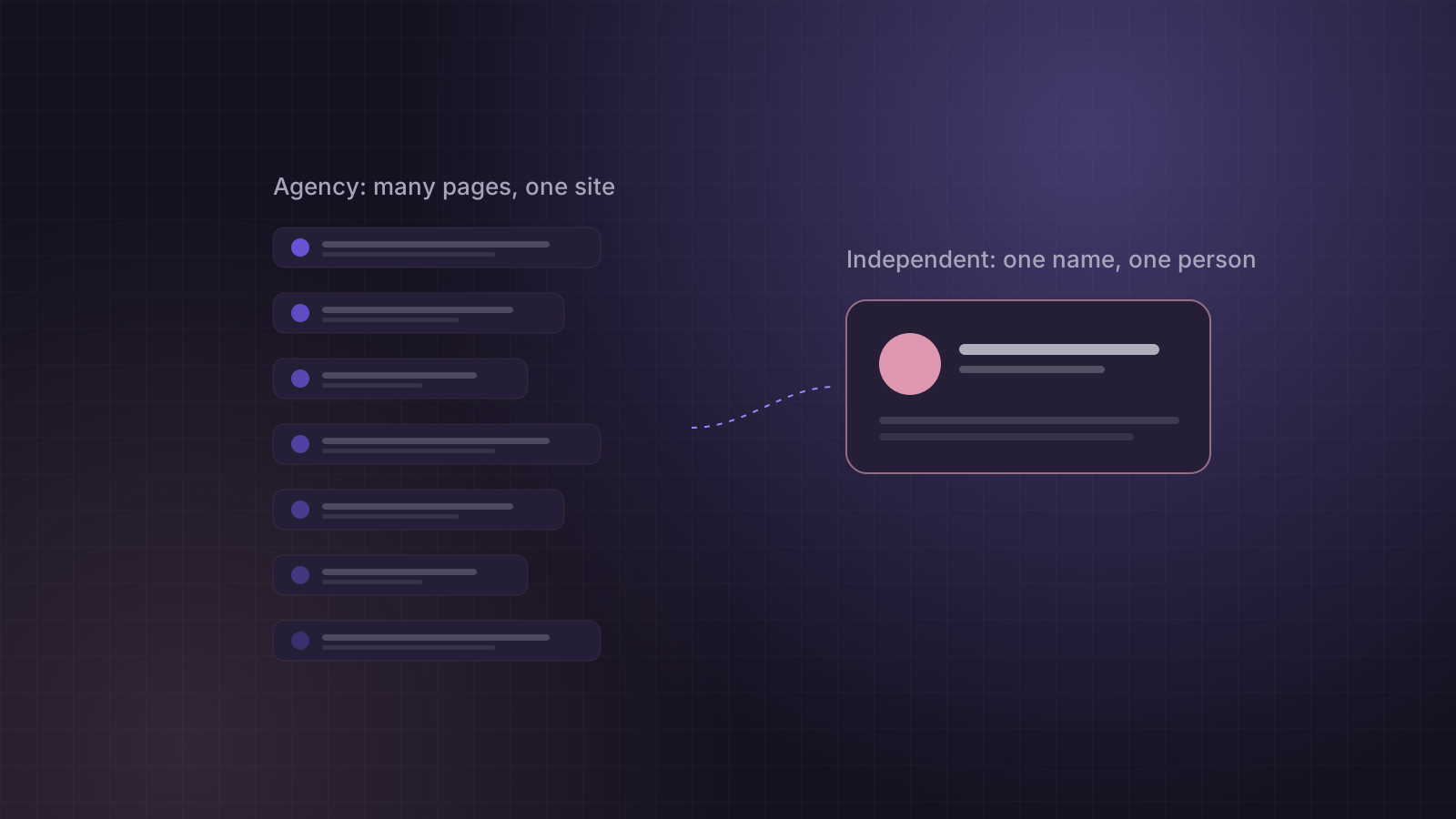
Google applies the same rules to agency and independent escort sites. What differs is where each one breaks. Agency sites usually fail because of scale: dozens of profiles, several cities and pages that change every week. Independent sites usually fail because of identity: one working name that has to point clearly to one site. So the first month of work looks completely different.
What each is trying to win
The two overlap, but they are not chasing the same searches, and that shapes everything after it.
| Search | Agency | Independent |
|---|---|---|
| Brand or working name | Important, usually easy | The main prize |
| Companion name plus agency | Important, often lost to directories | Not relevant |
| City searches with no name | The main prize | Possible in smaller cities |
| Name plus city | Handled through profiles | Very important if you tour |
An agency depends on city searches, because that is where new clients who do not know any names start. An independent's best clients usually already know the name, from a recommendation, a directory or a previous booking, and they search it directly.
Where agency sites break
Picture an agency with sixty profiles across three cities. Over a year, perhaps a third of those companions leave and new ones join. If each departure deletes a page, the site builds up dozens of dead URLs, each one with links and history that are thrown away. If each new profile goes live with two lines and a gallery, the site gains dozens of thin pages at the same time.
Then there are the city pages. Agencies often start with one good page for their home city, then copy it for the next two with the name changed. Google's spam policies describe that pattern as doorway pages, and it can hold back the whole set, including the original.
None of that is a writing problem. It is structure: rules for what a profile must contain before it is indexed, what happens when someone leaves, and how cities, profiles and services link together. That is why agency work starts with a crawl rather than with copy. The full list of fixes is on our agency SEO page.
Where independent sites break
An independent site is small, so every page carries more weight and every mistake shows. The most common problem is a blurred identity. The working name is spelled two ways, the bio differs between the site and three directories, and an old profile from years ago still ranks. Search engines see several half-matching sources and cannot tell which one is the real home of that name.
The second problem is privacy, and it shapes the SEO rather than sitting beside it. Photos reused from personal accounts can be matched by reverse image search. A domain registered without privacy protection can expose a real name. Making a name more searchable should never make the person behind it easier to find.
The third is technical and very common: an age gate that shows search engines a blank page. On a five-page site, that can mean nothing is indexed at all. Our independent escort SEO page covers the fixes, and the working name guide goes deeper on identity.
What is the same for both
Some things do not change with the size of the business.
- Google's SafeSearch filter hides escort services from people who have it switched on. Keeping explicit images in one clearly separated part of the site, or off it entirely, keeps more pages eligible for more searches.
- Directories are useful, but every profile you keep should match your own site and link back to it where the directory allows.
- Bought link packages from adult link networks are a risk to both, and a small independent site has fewer good signals to absorb the damage.
Search your brand or working name in a private browser window. If your own site is not the first result, start with identity. Then search "escort" with your main city. If you are nowhere in the first three pages, start with structure.
The legal shape comes first
In England, Scotland and Wales, the law treats an individual working for themselves differently from a business that organises or profits from other people's work. Offences such as controlling prostitution for gain and keeping a brothel apply to some business models and not others, and the details matter. We do not advise on how any escort business is legally structured; that is a question for a solicitor who knows this area of law well. SEO should only begin once the business is confident its model is lawful and that everyone involved is an adult working freely.
What to measure in each case
| Measure | Agency / Independent |
|---|---|
| Main searches | City and service searches / the working name, alone and with a city |
| Pages that matter most | City pages and profiles / home page and tour pages |
| Typical risk | Thousands of thin pages / copies of the name on other sites |
| First sign of progress | Profiles indexed and city pages climbing / the name ranking first |
Moving between the two
Some independents later work through an agency, and some leave an agency to work entirely alone. Either way, plan the change: decide which working name continues, where its main page will live, and how old profiles are redirected or removed. A working name that suddenly appears on two sites with different details confuses clients and search engines alike. Our guide to working-name SEO covers name changes.
Privacy is different too
An independent protects one person's privacy; an agency protects many. Agencies should make sure no profile reveals legal names, home areas or personal accounts, that photos are cleaned of location data, and that people who leave can have their profile removed quickly and completely. Independents carry the same duties for themselves. Either way, privacy work comes before any growth work, and it is never finished.
Directories sit in between
Directories host many independent advertisers but do not employ or manage them. Their SEO looks like an agency's in scale and like an independent's in its reliance on accurate, current profiles, with extra legal duties under the Online Safety Act that neither agencies nor independents carry in the same way.
Which kind of work you need
It comes down to how the site is organised, not how big the business feels. One working name on one site is independent work, even for someone who is very busy and tours widely. Several companions presented under one brand is agency work, even for a small agency. If your site is a listing platform where advertisers post their own ads, it is neither, and directory SEO is the place to start.
Prices for each are on our pricing page. Whichever applies, the first step is the same: an audit that tells you which of these problems your site actually has.
Sources
Each link opens the body's own website. Rules change, so confirm the current version there.
Questions we are asked
Can an independent outrank an agency?
Yes, for the searches that matter most to an independent: their working name, and their name with a city. Agencies usually do better on broad city searches because they have more pages and more links.
Should an agency create a page for every companion?
Only when the page can carry enough written content to stand on its own. Otherwise it adds to a pile of thin pages that weakens the whole site, and it is better kept out of the index until it is ready.
Is SEO cheaper for an independent?
Usually, because the site is smaller and the searches are narrower. Most of the work happens in the first month, then it becomes steady upkeep around tours and profile changes.